


The History of Satpam in Indonesia: How Security Guards Became a Pillar of National Safety

Satpam, or Satuan Pengamanan (Security Unit), can be found today in nearly every office building, shopping center, residential complex, and industrial estate across Indonesia. But did you know that this institution was born from a strategic decision made on December 30, 1980, driven by the limited number of police officers and the rising crime rates in urban areas? Understanding the history of how Satpam was formed in Indonesia is not merely about looking back at the past, it is the foundation for understanding why Satpam remains relevant even in today's era of advanced technology.
What is Satpam? The Official Definition Under Police Regulations
Satpam is a unit or professional group carrying out limited non-judicial police functions, formed through recruitment by security service providers or end-users of security services, to carry out security operations within the framework of self-initiated security (keamanan swakarsa) in their working environment. This definition is officially stated in Regulation of the National Police of the Republic of Indonesia Number 4 of 2020 on Self-Initiated Security (Perpol No. 4/2020).
The word "satpam" itself is a direct translation of the English term security guards. To this day, the word "sekuriti" is still commonly used in everyday conversation as its informal equivalent. Administratively, every Satpam member is required to be registered and recorded as part of the police ecosystem in Indonesia.
Why Was Satpam Necessary? The Historical Background
Satpam was established due to two main pressures: first, the number of National Police (Polri) personnel was too limited to cover all office and commercial areas. Second, the rise of organized crime, including thuggery (premanisme) in these areas in the late 1970s. The police recognized that they could not work alone in creating public safety and order.
The Limited Number of Police Personnel
By the end of the 1970s, the ratio of Polri personnel to the total population was still very low. With limited personnel, Polri could not possibly station officers in every office building, industrial estate, or commercial area that continued to expand rapidly alongside urbanization. An efficient solution was needed: a security unit funded by the companies or institutions using the service, while still operating under police supervision.
The Rise of Organized Crime in Urban Areas
The rapid economic growth and urbanization during the New Order era brought with it a rise in organized criminal activity. Thuggery proliferated across urban areas, particularly around commercial and industrial zones. This condition strengthened the urgency of establishing a specialized security unit capable of serving as the frontline guardian in these high-risk locations.

A Historic Milestone: Kapolri Decree No. SKEP/126/XII/1980
Satpam was officially born through the Chief of National Police (Kapolri) Decree Number SKEP/126/XII/1980, dated December 30, 1980, concerning the Framework for the Development of Security Units. This date was later established as Indonesian Satpam Day, commemorated annually. On December 30, 1993, Polri officially recognized General of Police (Ret.) Prof. Dr. Awaloedin Djamin as the Father of Indonesian Satpam.
This Kapolri Decree is far more than just an administrative document. It established the framework for Satpam development, including the functional relationship between Satpam and the police, training standards, and recruitment procedures. The connection between Satpam and Polri does not stop at uniforms and duties, the security techniques and methods taught to Satpam personnel are based on the same materials given to police personnel.
The Figure Behind Satpam: General of Police Awaloedin Djamin
General of Police (Ret.) Prof. Dr. Awaloedin Djamin was the figure who proposed and championed the establishment of Satpam in Indonesia. He formed Satpam based on his observation that the number of police officers was insufficient to secure all working areas, while simultaneously responding to the rise of organized crime. For his contributions, Polri honored him as the Father of Indonesian Satpam on December 30, 1993.
Awaloedin proposed the concept of Satpam being funded by the companies or institutions using the service. He also asserted that Satpam personnel are not merely "door guards", they must receive education and security training equivalent to police standards, making them professional partners of Polri rather than just additional manpower.
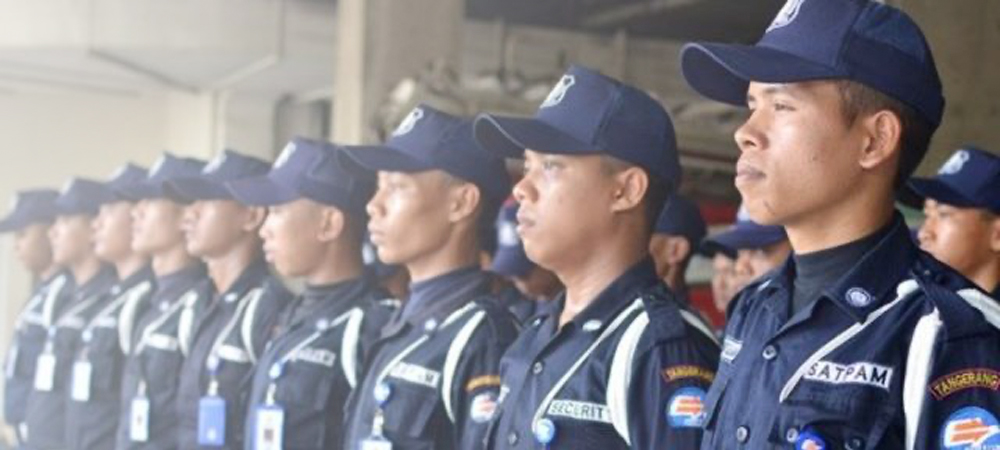
The Evolution of Satpam Uniforms: From Blue-and-White to Cream-and-Brown
The Indonesian Satpam uniform has undergone significant changes since its inception in 1980. The blue-and-blue and blue-and-white uniforms that lasted for 40 years were officially replaced in early 2021 with cream tops and dark brown bottoms, based on Article 45 of National Police Regulation Number 4 of 2020. This change was later reinforced through Perpol No. 1 of 2023 to clarify the visual distinction between Satpam and Polri personnel.
Blue-and-White (Field) and Blue-and-Blue (Building) Uniforms
Established by Awaloedin Djamin during the formation of Satpam. White top + dark blue pants for building Satpam, full blue for field Satpam. Lasted for approximately 40 years.
Light Brown Uniform — Article 45 of Perpol No. 4/2020
The official uniform changed to light brown (top) + dark brown (bottom), resembling the Polri uniform. This change was intended to foster pride in the profession and emotional closeness between Satpam and Polri.
Cream Uniform — Perpol No. 1 of 2023 (Currently in Effect)
Chief of National Police General Listyo Sigit Prabowo enacted the color change on January 13, 2023. The cream color was selected through an agreement between ABUJAPI (Indonesian Security Service Business Association) and Korbinmas Polri so that Satpam would remain in the same visual family as Polri, while being more easily distinguishable by the public.
The Evolution of Satpam: From Manual Guards to Integrated Systems
Since its birth in 1980, the role of Satpam has continued to evolve alongside the development of technology and the increasing complexity of security threats. Modern Satpam no longer work alone, they are part of an integrated security ecosystem that combines CCTV surveillance, access control systems, alarms, and 24-hour monitoring centers. Yet, it is precisely because of this technology that the role of Satpam becomes even more crucial: technology requires humans to assess situations and take action.
Today, Satpam can be found in nearly every aspect of life, from offices and high-rise buildings to shopping centers, industrial estates, residential complexes, and educational institutions. Regulations also continue to be updated: Perpol No. 4 of 2020 is proof that the state continues to adapt the legal framework of Satpam to the dynamics of contemporary security.
The Satpam training system has also undergone significant formalization. Today, there are three recognized levels of Satpam training designed to ensure that the competency of Satpam personnel matches the complexity of the environments in which they are deployed.
SECOM's Role in Indonesia's Satpam Ecosystem
For more than 30 years of operating in Indonesia, SECOM has been present with an approach that goes beyond the paradigm of "conventional Satpam." Through SECOM Bhayangkara, the company collaborates with the Brata Bhakti Polri Foundation. SECOM ensures that every security personnel provided not only meets Polri standards but is also trained according to the rigorous standards of SECOM Japan.
This is what is known as the Man-Machine philosophy: the belief that the best security system is one that harmoniously combines trained human personnel with advanced technology. SECOM Satpam personnel are not merely guards, they are operators of an integrated security system equipped with the support of the SECOM 24/7 monitoring center.
SECOM Satpam personnel are not merely guards, they are part of an integrated security system that encompasses technology, monitoring, and physical response. Consult with SECOM regarding the security risks at your location.