


Hotel Security: A Guide to Securing Guest Areas and Back-of-House Areas
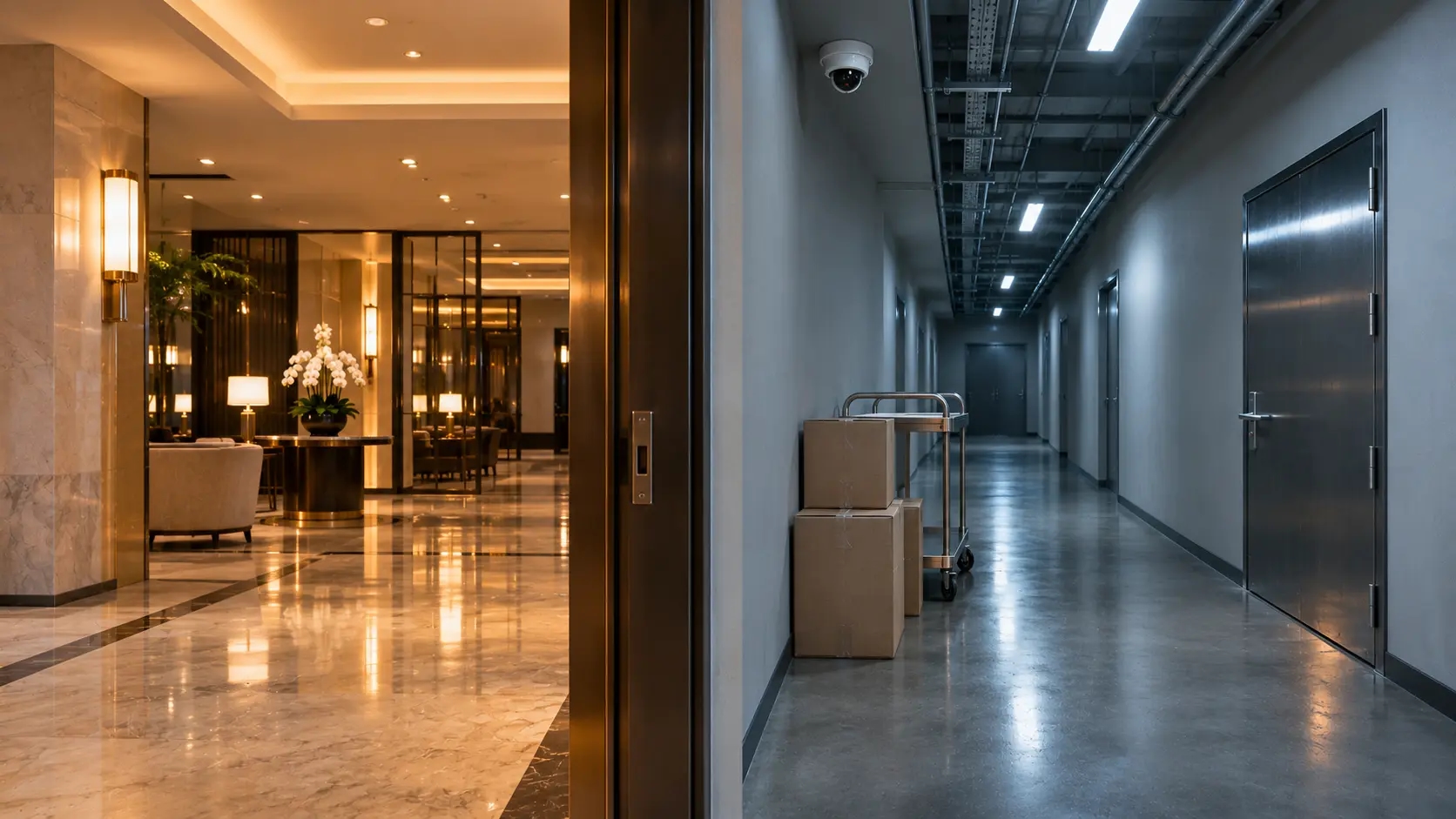
Hotel security is usually discussed from the side guests can see: cameras in the lobby, staff at the entrance. Indonesia's hotel business standards, issued by the Ministry of Tourism, do set minimum facilities for exactly that. The previous standard (Ministry of Tourism and Creative Economy Regulation No. 4 of 2021, or Permenparekraf 4/2021), for example, required CCTV in guest lifts of medium-high and high-risk hotels in buildings of five floors or more. The standard now in force is Ministry of Tourism Regulation No. 6 of 2025 (Permenpar 6/2025), effective 10 October 2025.
Passing a licensing checklist does not mean the gaps are closed. They are often in places guests never see: the loading dock, F&B storeroom, kitchen, server room, and electrical panel room.
What Do Hotel Business Standards Require for Security?
The star-hotel standard sets minimum qualifications for the business: facilities, human resources, product requirements, and management systems. On security, its items focus on facilities and safety, such as guest lifts, corridors with rescue access, portable fire extinguishers (APAR), and, under the old standard, CCTV in lifts.
Permenpar 6/2025 revoked Permenparekraf 4/2021, but the old document is still widely quoted. Make sure your consultant or vendor works from the current version.
Building size also helps determine the risk level. According to the Ministry of Tourism's Sisupar portal (KBLI 55110, star hotels), a star hotel with a building area of up to 6,000 m² is medium-low risk, while a larger one is medium-high, with a Self-Assessment Document and heavier verification.
The standard only answers whether the facilities exist. Who holds the master key? Does the loading dock door have access control, and who moves when an alarm sounds at 2 a.m.? The standard does not answer property-level questions like these, yet sound security starts there.
How Do You Secure Guest Areas: Lobby, Lifts, Corridors, and Room Access?
Guest-area security rests on three layers: CCTV at entry points and circulation routes, key cards that restrict lift access by floor, and control over people who are not guests. The aim is to guide movement without disturbing guest comfort.
Hotel CCTV in the Lobby, Lifts, and Corridors
Good camera placement follows how people move, instead of splitting the camera count evenly. Priority points usually include:
the main entrance, drop-off, and reception
inside guest lifts (an item in the old standard)
corridor ends, emergency stairs, and doors between floors
parking entrances and the route to the lobby
Image quality matters as much as camera count: clear enough to recognize a person, with consistent lighting all night. Footage that cannot be used to trace an incident only gives a false sense of security.
Hotel Lift Card Access and Controlling Non-Guests
Lift card access limits which floor buttons work, according to the cardholder's permissions. A guest card opens only the guest floors and public areas, while a staff card follows work area and shift. Someone with no business on the guest floors cannot simply ride a lift up to them.
What often gets missed:
Service and freight lifts. Guest lifts are usually locked by floor, service lifts often are not, even though they connect the guest floors to the back of house.
Event visitors. Ballroom and restaurant guests are not staying in the hotel, so floor zoning and dedicated routes should keep them away from the room floors.
Visitors to guests. Logging them and issuing temporary cards with limited access is easier to trace than relying on the front desk's memory.
Lift restrictions do not replace human oversight. Receptionists, concierges, and security officers still judge the situation, and the technology makes sure their decisions can be enforced.
Why Does the Back of House Need More Attention?
The back of house holds valuable stock, operating equipment, and the infrastructure behind hotel service, yet movement through it is rarely as orderly as in guest areas: many doors, many vendors, few people watching. Attention here has a large effect on operational continuity.
For example, at 2:10 a.m. the loading dock door stays open for more than ten minutes after the last delivery. No guest sees it, and the night staff are in the lobby. Perhaps nobody means any harm, but no system records who came and went in that window.
Loading Dock and Vendor Access
The loading dock is the biggest gateway into the back of house. What needs designing:
vendor registration before vehicles enter, with identity and purpose
cameras that cover the handover and weighing points, not just the gate
an alert when a dock door is left open
vendor routes kept separate from staff and guest routes
F&B Storeroom and Kitchen
The F&B storeroom holds valuable stock that many people draw from in a day. Per-person access control is easier to audit than physical keys passed from hand to hand. In the kitchen, point CCTV at goods routes and doors rather than excessively monitoring employees' work areas, so oversight stays professional.
Server Room and Electrical Panel Room
These two rooms are rarely visited, but a fault in either is felt across the whole hotel: reservations, electronic room locks, air conditioning. Access should be limited to named personnel, logged, and fitted with a door alarm. The principle is the same as physical data center security, at hotel scale.
Staff Areas
Staff entrances, lockers, and goods exit routes belong to the same chain of control. Consistent checks and cameras at exit points protect hotel property, and they also protect employees from unfounded accusations.
Who Holds the Master Key and Access Cards?
Master keys and staff access cards open almost every door. Every credential therefore needs an owner, a validity period, and a usage trail that can be checked. Without that, access gets harder to trace as staff come and go.
Audit questions worth asking:
Is there a record of who holds each master key, when it was taken, and when it was returned? A key management system can log this without a paper book.
Is deactivating a departed employee's card part of offboarding on the last working day, and who makes sure it happens?
Does anyone read the access logs? Logs that are never reviewed are useless. Odd patterns, such as access outside shifts or the same door opened repeatedly, show up only through regular review.
How Far Can Hotel CCTV Record? Guest Privacy and the PDP Law
CCTV must not be installed in guests' private spaces such as rooms, bathrooms, and changing rooms. Footage that shows a person's face can count as personal data, so who may open recordings, and for what purpose, must be restricted and logged.
Security and privacy can coexist, and a hotel that handles both well earns more guest trust. The written policy should cover:
excluded locations, namely guest rooms, toilets, changing rooms, and spa treatment areas, including corridor camera angles that could capture the inside of a room when the door is open
who may open recordings (for example the Security Manager and GM), how internal and law-enforcement requests are handled, and a log of every access
signage that the area is under CCTV monitoring, at the relevant points
a retention period, set according to internal policy and investigation needs
The legal framework is Law No. 27 of 2022 on Personal Data Protection (PDP Law). Its implementing regulation, Government Regulation No. 33 of 2026, has been issued and takes effect on 16 January 2027. Check the status of the supervisory authority at the time you read this.
Who Knows, and Who Arrives, When Something Happens After Hours?
After hours, two questions decide the outcome: who receives the alert, and who arrives on site. A good system answers both. Sensors or cameras detect, a monitoring center verifies, trained personnel respond.
Midnight tests a hotel's security system. The back of house is empty, staffing is at a minimum, and no guest is around to report anything. What to confirm:
alarms at the loading dock, storerooms, and server room reach a party that actually monitors them, instead of sounding only on site
written procedures for each alert type: who verifies, who is contacted, when personnel are dispatched
responders are trained and know the property layout
This is the situation SECOM's Man-Machine approach is built for. Technology provides early warning and traceable footage. Trained personnel from SECOM Bhayangkara make sure a person judges and acts, with Control Center SECOM as the monitoring point that links the two.
How Does SECOM Indonesia Support Hotel Security?
SECOM Indonesia supports hotels with technology and personnel. Access control, CCTV, and alarms for the back of house come from SECOM Indonesia, while security personnel come from SECOM Bhayangkara. We have been in Indonesia for more than 30 years, backed by SECOM Japan, founded in 1962, and we see security as one integrated system. For a hotel, that means:
per-person access control at the loading dock, storerooms, server room, and panel room, with logs that can be reviewed
CCTV and alarms placed by the flow of people and goods, not by point count
security officers who work alongside the system and are monitored through Control Center SECOM
a security assessment of the operating property, with prioritized findings rather than a shopping list
For Japanese hotel groups operating in Indonesia, this approach fits Anshin, the calm that comes from a well-ordered system rather than from excessive vigilance. Guests and management do not have to keep thinking about security, because the system works behind the scenes.
Every property is different. Compatibility with installed systems is assessed during the site survey, and we do not promise that every device can be integrated before it has been inspected.
Schedule a security assessment or site survey for your hotel property.
Want to know how your hotel's back of house compares with the checklist above? Our team can run a site survey and prepare findings you can act on in stages.