


Mine Site Security in Indonesia: Vulnerable Points and a Site Audit Checklist
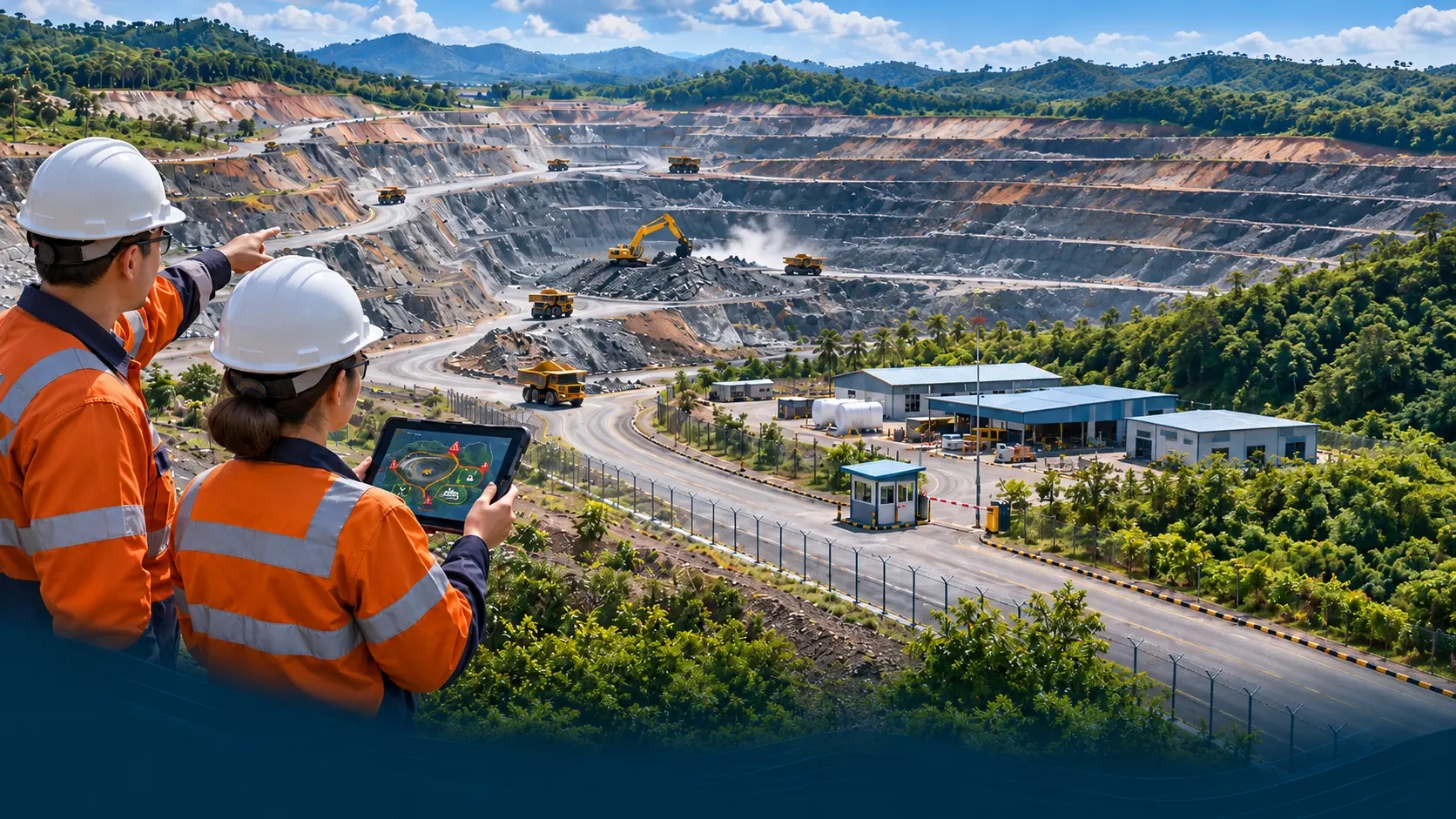
Indonesia's Energy and Mineral Resources Ministerial Regulation No. 48 of 2018 (Permen ESDM 48/2018) puts responsibility for securing national vital objects in the energy and mining sector on the operators themselves, under a principle of internal security (peraturan.go.id). One example: Antam's North Konawe Nickel Mining Business Unit, which holds a production operation mining permit (IUP OP) covering 23,133 hectares, was designated a national vital object in 2022 (IDX Channel). Picture securing an area that size.
Scale like that changes the question. You stop asking how many cameras you need and start asking where security actually makes the difference, and how to split the work between people and technology. That question usually lands with the Kepala Teknik Tambang (KTT, the mine's legally appointed technical head), the site manager, the security or HSE superintendent, and the procurement team drafting the security contract.
Why Is Mine Security Different from Industrial Estate Security?
Mine sites are huge, remote, run around the clock and hold assets that move: heavy equipment, fuel and spare parts. Security has to be planned zone by zone, according to risk. A fence and a few guard posts around the boundary won't cover it.
Four traits set a mine site apart:
Sheer size. A factory has a clear boundary. A mine site can stretch across thousands of hectares with access from many sides. Guarding the full perimeter isn't realistic, so you have to set priorities.
Distance from town. Response times, power supply and communications coverage are design factors from day one.
24-hour operations. Night shifts, crew changes and unit traffic never stop. Gaps tend to open during handovers.
Moving assets. Units, fuel, cable, tyres and components move between areas every day. Security has to follow those movements as well as protect buildings.
That mix is why the Man-Machine approach fits mining. Technology extends coverage to points people can't watch around the clock, while trained personnel assess what's happening and act. SECOM Indonesia has worked this way across industrial facilities since 1994.
What Does National Vital Object Status Mean for a Mine Operator?
For operators, national vital object (obvitnas) status means running security is their own responsibility, under the internal security principle. The Indonesian National Police (Polri) is obliged to provide security assistance. The police supplement the site's security system. They don't replace it.
Operator responsibility is set out in Article 9 of Permen ESDM 48/2018, and the police's obligation comes from Article 4(2) of Presidential Decree (Keppres) 63/2004. The list of energy and mining vital objects is set by ministerial decree and has been amended several times. Antam's North Konawe unit was added by Kepmen ESDM 270.K/HK.02/MEM.S/2022, dated 22 November 2022. In practice, this means three things for the site team:
The operator designs and runs its own security system: people, procedures and equipment.
Polri provides support. Roles, coordination lines and contact lists should be agreed before an incident happens.
Vital object operators are also expected to implement a security management system under prevailing regulations.
Not every mine holds vital object status, but the risk profile is similar, so the principle of internal responsibility is still a sound benchmark. This is general information, not legal advice. Confirm the specific obligations for your site with legal counsel and the relevant authorities.
Where Are a Mine Site's Vulnerable Points?
Vulnerable points usually cluster in five areas: gates and haul roads, the fuel station, workshops and spare-parts stores, stockpiles and ports, and employee accommodation. Map them first. Then decide where security spending will have the most effect.
Main Gate and Haul Roads
Everything that enters or leaves passes the gate: employees, contractors, visitors, trucks and units. It's the most effective place to control who and what gets through, and the easiest place to create a queue if the design is wrong. Long haul roads have junctions and side access points that need mapping, including the ones rarely used.
Fuel Station and Fuel Tanks
Fuel risk isn't confined to the tank. It sits at the dispensing point, in transport and in the records. Useful controls against fuel theft at a mine include restricted access to the refuelling area, recording at the dispensing point and routine reconciliation of dispensing records against physical stock. A discrepancy caught early is far easier to trace.
Workshops and Spare-Parts Stores
Cable, tyres and high-value components are easy to move and hard to track when a store keeps no in-and-out log. Per-person access control and a camera at the store door mean every movement of goods leaves a trail.
Stockpiles and Ports
Ore that has been stockpiled and loaded carries direct value. Weighbridges, loading areas and ports need recording and monitoring that match the shipping documents.
Employee Accommodation
Mess and camp areas involve residents' safety as well as orderly access for guests and visitors. Security here keeps the place comfortable, with tidy access control and personnel who are easy to reach.
How Should Site Security Support the Explosives Magazine?
Commercial explosives magazines are tightly regulated under National Police Chief Regulation (Perkapolri) 17/2017 on the licensing, security, supervision and control of commercial explosives, with Polri oversight (peraturan.go.id). Site security supports that regime. It tightens access control on the approach to the area and record-keeping around it, without replacing the regulations or police oversight.
What the site security team can make sure of is the surrounding area: access to the zone is logged, approach routes are monitored and coordination with the authorities runs smoothly. Any equipment added here should be discussed first with the authorities and the person responsible for explosives on site.
What Security Layers Work on a Mine Site?
Effective mine site security comes in four layers: the gate, the perimeter and vulnerable points, logged patrols, and personnel at posts. Each layer covers another's weak spots, so a single gap doesn't escalate straight into an incident.
Layer | Purpose | Equipment and Personnel |
|---|---|---|
Gate | Control who and what enters or leaves | Access control, UVSS (under-vehicle surveillance), road blockers, rising bollards, X-ray at inspection posts |
Perimeter and vulnerable points | Watch areas people can't guard continuously | CCTV, alarms |
Patrol | Make sure areas are checked on schedule and documented | Digital Guard Patrol |
Posts and response | Assess alerts, decide, act | Trained security personnel from PT SECOM Bhayangkara |
At the gate, UVSS, road blockers and rising bollards make vehicle checks consistent instead of depending on one person staying alert. X-ray adds item screening at inspection posts. On the perimeter, CCTV and alarms extend line of sight to the vulnerable points you've already mapped.
Patrols are often the layer most dependent on habit. Digital Guard Patrol records checkpoints and times, so supervisors can match reports against the routes actually walked.
Equipment with nobody to follow up only produces footage. Personnel without equipment work with limited sight. That's why SECOM Indonesia supplies gate equipment and systems through PT SECOM Indonesia and personnel through PT SECOM Bhayangkara, designed as one plan.
Remote sites come with a practical limit: available power and communications decide which equipment can realistically be installed. That's why a site survey comes before equipment selection.
How Do You Manage Insider Risk Without Accusing Workers?
Insider risk is best managed through objective records: access logs, verifiable footage, task rotation and segregation of duties. A fair system protects honest workers, because every event leaves a trail that can be checked.
Individual access logs. Who entered which area and when is recorded automatically, so tracing a discrepancy doesn't depend on anyone's memory.
Footage for verification. When a stock discrepancy appears, footage helps find the real cause and rules out wrong suspicions.
Task rotation. Rotating guards across posts and sensitive areas reduces dependence on any one person and keeps procedures alive.
Segregation of duties. The people who dispense, record and check should be different people.
Can Mine Security Guards Be Outsourced?
Yes. Manpower Ministerial Regulation No. 7 of 2026 (Permenaker 7/2026) on outsourced work, in force since 30 April 2026, lists security among the six support activities that may be outsourced (Article 3(2)). The Labour Protection Law (UU Pelindungan Ketenagakerjaan) approved by the House of Representatives on 6 October 2026 also keeps security services on its list of outsourceable support services. The Ministry of Manpower says the new law takes effect after a one-year transition from its promulgation, so Permenaker 7/2026 remains the working reference today. Obligations toward workers' rights still apply.
The details are still moving, including a planned revision of Permenaker 7/2026 and the new law's transition period, so have your legal counsel review the contract. For mine security guards, procurement can check the following:
The provider is a security services company (BUJP) licensed by the police.
Personnel are trained, with clearly defined training levels.
A written outsourcing agreement is registered by the provider with the manpower office where the work is performed, which for a mine means the office covering the site.
Outsourced workers' rights are stated clearly in the contract, since the company awarding the work shares responsibility for making sure those rights are met.
The provider can supervise, report and integrate with the site's technology.
Mine Site Security Audit Checklist
Use this as a first-pass audit. Any answer of "not sure" marks an area worth a closer look.
Gate and access
Is every person and vehicle entering recorded (identity, purpose, time)?
Are vehicles checked at the gate, including the underside, with physical barriers that can be raised when needed?
Are haul roads and side access points mapped, including rarely used ones?
Vulnerable points
Does the fuel station have restricted access, recording and routine reconciliation of dispensing records against physical stock?
Does the spare-parts store log items in and out by person?
Do stockpile and port records match the shipping documents?
Technology and patrol
Do CCTV and alarms cover priority vulnerable points, and when were they last tested?
Are patrols logged (checkpoint, time, officer), and is the data reviewed regularly?
Have backup power and communications at remote points been accounted for?
People and procedures
Are roles with Polri, contact lists and coordination lines documented and rehearsed together?
Are post personnel trained, and is there task rotation?
Is the alarm escalation procedure clear: who assesses, who acts, and within how many minutes?
Governance
Does the security services contract meet outsourcing rules, state workers' rights and include measurable performance indicators?
Do CCTV notices and footage handling for workers comply with Indonesia's Personal Data Protection Law (UU PDP)?
From Checklist to Peace of Mind
Working with SECOM Indonesia starts with a security assessment. Our team visits the site, maps vulnerable points, assesses current security and builds recommendations that combine equipment and personnel. You get a priority map to discuss with management and procurement, not a shopping list.
With more than 30 years in Indonesia and Japanese standards behind it, SECOM Indonesia helps site teams stay focused on production while security runs, measurably, in the background.