


The 5S Security Standard in Indonesia: Senyum, Salam, Sapa, Sopan, Santun Explained
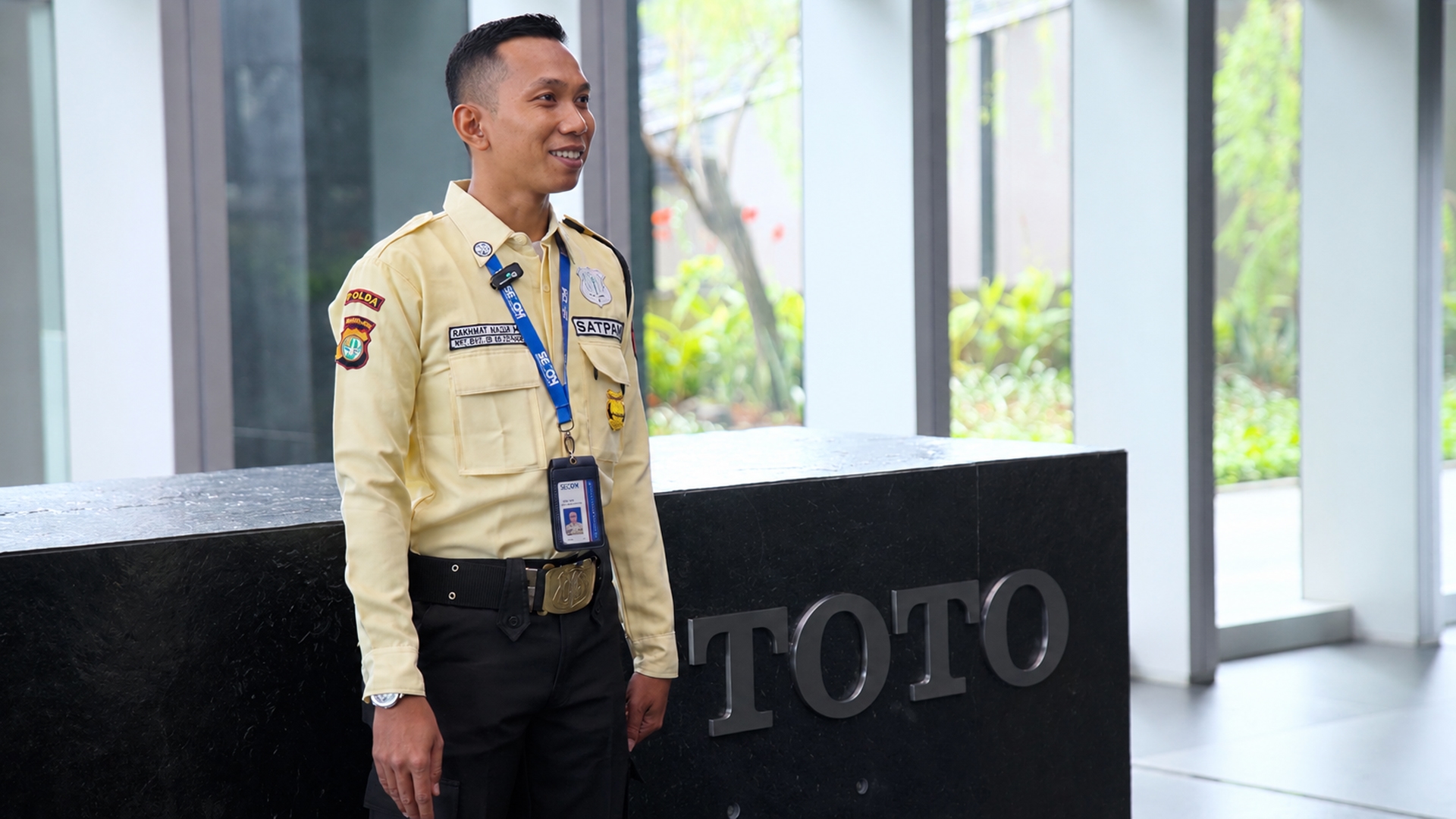
In Indonesian security practice, 5S stands for Senyum, Salam, Sapa, Sopan, Santun — smile, greeting, addressing the visitor, politeness, and courtesy. A satpam (the Indonesian term for a licensed security officer) applies these five behaviours to everyone who reaches the post: visitors, employees, vendors, couriers, anyone.
If you arrived here expecting Sort, Set in Order, Shine, Standardize and Sustain, you're thinking of the other 5S. Both versions circulate in the Indonesian security industry. Both are legitimate. They govern completely different things, and confusing them at the SOP drafting stage produces a document that's broken from page one.
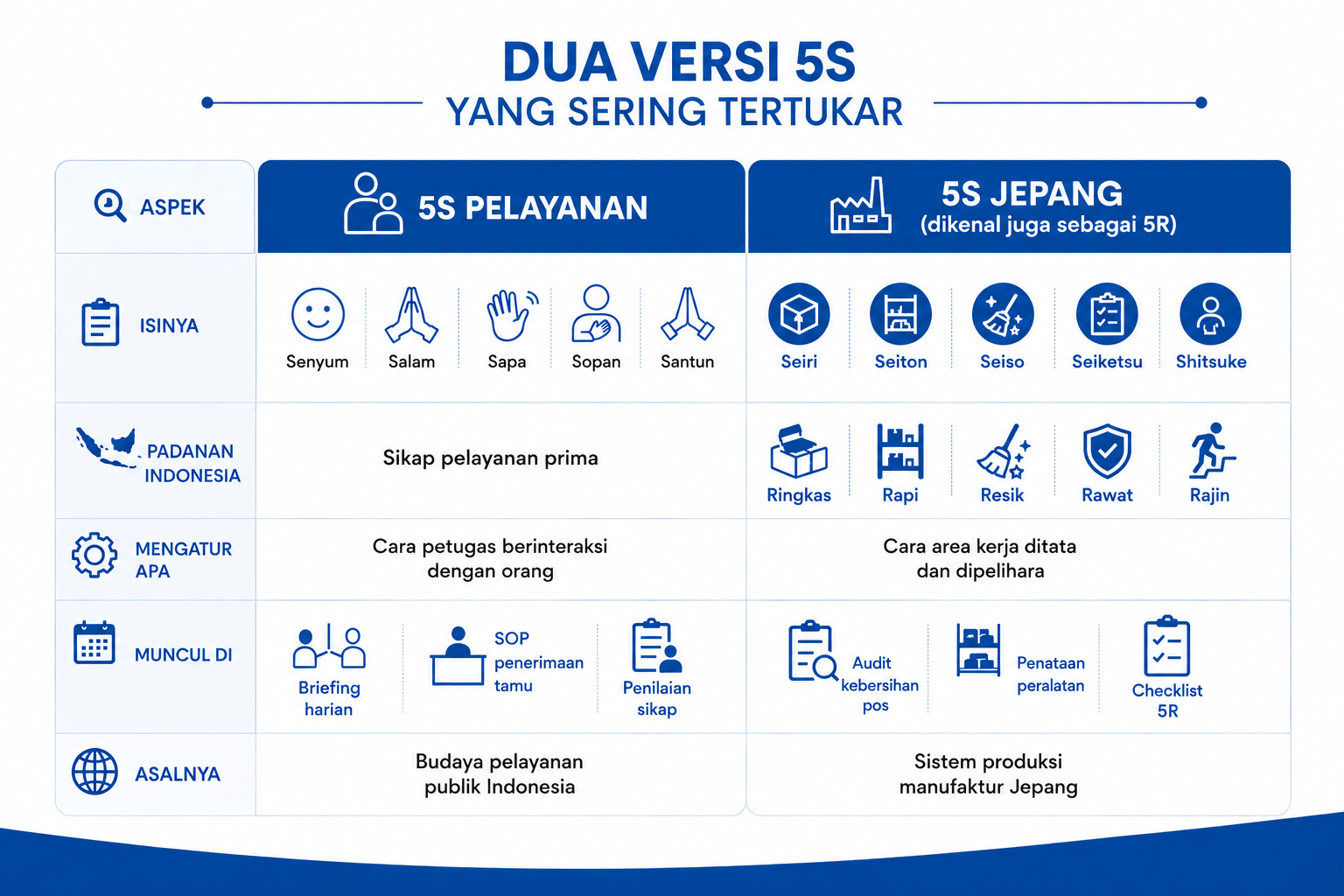
Two Versions, One Abbreviation
Aspect | Service 5S | Japanese 5S (known locally as 5R) |
|---|---|---|
The five terms | Senyum, Salam, Sapa, Sopan, Santun | Seiri, Seiton, Seiso, Seiketsu, Shitsuke |
In English | Smile, greet, address, be polite, be courteous | Sort, set in order, shine, standardize, sustain |
Indonesian equivalent | Sikap pelayanan prima (service conduct) | Ringkas, Rapi, Resik, Rawat, Rajin |
What it governs | How officers interact with people | How the work area is arranged and maintained |
Where it shows up | Daily briefings, visitor-reception SOPs, conduct appraisals | Guard post housekeeping audits, equipment layout, 5R checklists |
Where it came from | Indonesian public service culture | Japanese manufacturing |
A rough guide for foreign managers reading their vendor's documents. If a supervisor says "5S" during the morning briefing while talking about how to receive guests, he means Senyum, Salam, Sapa, Sopan, Santun. If the term appears on a guard post audit sheet next to a photo of a supply cabinet, it's the Japanese one.
The rest of this article covers the service version, since that's what most people are actually asking about.
What Each S Means at the Guard Post
Senyum — smile
A friendly expression. Not stiff, not forced, and not a sign that the officer has switched off. The function is to lower the temperature of whoever just walked in, especially a visitor already irritated by Jakarta traffic or running late for a meeting.
Salam — greeting
Opening with a time-appropriate greeting: selamat pagi, selamat siang, selamat sore. Sounds trivial. But the greeting creates a natural opening for whatever question comes next, and at an access point that matters more than it looks.
Sapa — address the person, ask their business
"Ada yang bisa saya bantu?" (Can I help you?) or "Who are you here to see?" This is what turns an identity check into a conversation instead of an interrogation.
Sopan — politeness
Speaking and behaving respectfully toward everyone, without sorting people by appearance, vehicle, or job title. The motorcycle courier gets the same treatment as the director in the sedan. In practice this is the point that leaks most often.
Santun — courtesy sustained under pressure
Maintaining tone and conduct for the whole shift, including while refusing entry, correcting a parking violation, or dealing with somebody who is shouting. Santun is tested in the difficult moments, not the easy ones.
The Security Function Behind the Courtesy
The most common misreading of 5S is that it's a hospitality programme, something for the company's image rather than its safety.
That's wrong.
Greeting removes anonymity. The most valuable asset available to someone with bad intentions is the ability to pass through unseen. An officer who addresses every person forces eye contact and a short exchange of words. The face is seen, the voice is heard, the stated purpose is recorded. A lot of intrusion attempts end right there, with no confrontation at all.
A greeting opens the door to verification. Compare two sentences. "Where are you going?" against "Good afternoon, may I know your name and who you're here to see?" Same information requested. Very different response. The first invites defensiveness; the second gets people answering voluntarily and in full.
A smile de-escalates. Disputes in lobbies and parking areas rarely explode because of the rule itself. They explode because of how the officer delivered it. A flat face and a raised voice invite resistance.
Politeness and courtesy are legal protection. A satpam's authority is limited to the premises he guards. An officer who is rude can drag the company into a formal complaint, a viral social media post, or litigation. The risk is real and the cost is high.
There's one more benefit that gets discussed far less. An officer who greets everyone every day gradually builds a baseline of normal behaviour for that site: who usually arrives at what hour, who uses which door, what ordinary body language looks like there. When something breaks the pattern, he feels it before he can explain it. The best sensor in a building is often not the camera. It's the guard who actually knows the occupants.
Where the Rules Come From
The phrase "Senyum, Salam, Sapa, Sopan, Santun" doesn't appear as a specific article in Indonesian police regulation. What's regulated is the duty underneath it.
The satpam profession was established on 30 December 1980 through SKEP/126/XII/1980 on the Development of Security Units, signed by National Police Chief Awaloedin Djamin. Indonesia still marks that date as Hari Satpam, National Security Guard Day.
The regulation in force today is Peraturan Kepolisian Negara Republik Indonesia (Perpol) No. 4 of 2020 on Self-Managed Security, issued in Jakarta on 5 August 2020 by National Police Chief Idham Azis. It revoked two earlier rules at once: Perkap No. 23 of 2007 on Environmental Security Systems and Perkap No. 24 of 2007 on Security Management Systems. The current regulation covers the formation of guard units, rank structure, training and competency levels, uniforms, and the rights and obligations of members.
Perpol No. 4/2020 positions the satpam as a holder of limited police functions within his workplace, with a duty to protect, to shelter, and to serve. Those last three words are what the industry translated into 5S. The regulation sets the obligation; 5S is what it looks like at the gate.
Government institutions have since adopted it through internal decrees. The Kaimana District Court in West Papua, for one, issued a dedicated decree on its 5S Movement in 2024. Several religious courts run 5S and 5R together as a single programme.
The Japanese 5S: Seiri, Seiton, Seiso, Seiketsu, Shitsuke
This version came off Japanese factory floors long before it reached security work.
Seiri (sort) means separating what's needed from what isn't and removing the rest. Seiton (set in order) gives every item a fixed home so it can be retrieved in seconds. Seiso (shine) is cleaning while inspecting equipment condition. Seiketsu (standardize) turns the first three steps into a written standard. Shitsuke (sustain) is the discipline that keeps the standard from decaying by week three.
At a guard post the application looks unglamorous and pays off anyway. Torch, visitor logbook, spare keys, radio: each has a fixed position. The night shift officer can reach the torch in the dark without thinking about it. During an incident, no time is lost hunting for equipment.
SECOM was founded in Tokyo in 1962 as Japan's first security services company. This kind of ordering discipline has been part of how the company works for decades, and it carried across into SECOM's operational standards in Indonesia.
Making 5S Survive Past the Poster
Most 5S programmes die in month two. The pattern is always the same. A poster goes up at the guard post, the term gets mentioned once at a briefing, and everyone returns to their old habits.
Four things separate a programme that runs from one that doesn't.
Write greeting scripts that are specific to each post. The greeting in an office lobby is not the greeting at a warehouse gate at two in the morning. Generic scripts get used by nobody.
Train 5S together with screening procedure, never separately. An officer has to know how to ask for ID while staying warm. Split the training and you get one of two field outcomes: the friendly guard who forgets to verify, or the strict guard who offends every visitor.
Measure something observable. The percentage of visitors greeted within the first ten seconds. Complaints about officer conduct per month. Results from mystery visitor checks. The metric can be crude, as long as it's recorded consistently.
Appraise supervisors too, not only the officers. Conduct in the field follows the tone set at briefing. This one holds up almost every time I've seen it tested.
Where It Goes Wrong
A guard who smiles warmly and waves a visitor through without logging any identity is not a 5S success story. That's a failure wearing the costume of good service.
The opposite error is just as common. The officer memorises 5S as ceremonial text, delivers the greeting in a monotone, and never lifts his eyes from his phone screen. Visitors can tell the difference between a real greeting and a recited one.
Then there's selective treatment. Guests arriving by car get the warm welcome; couriers and day labourers are waved past. By risk logic that's backwards. The people who come and go most frequently are the ones whose verification should be tightest.
Conduct Standards Need a System Underneath
5S determines the quality of the first thirty seconds after someone enters your building. Those thirty seconds decide whether a visitor feels welcomed or suspected, and whether the officer got the chance to verify who just walked past him.
Conduct alone isn't enough, though. Even the best officer needs an orderly post, clear procedure, a fast reporting line, and support systems that keep working while his eyes are pointed somewhere else.
SECOM Bhayangkara supplies trained security personnel with measurable service and screening standards, while SECOM Indonesia handles the system side through alarms, access control, and centralised monitoring. To discuss security requirements at your site, contact our team to schedule a survey.