


How to Prevent Warehouse Theft: A Practical Guide for Logistics Managers
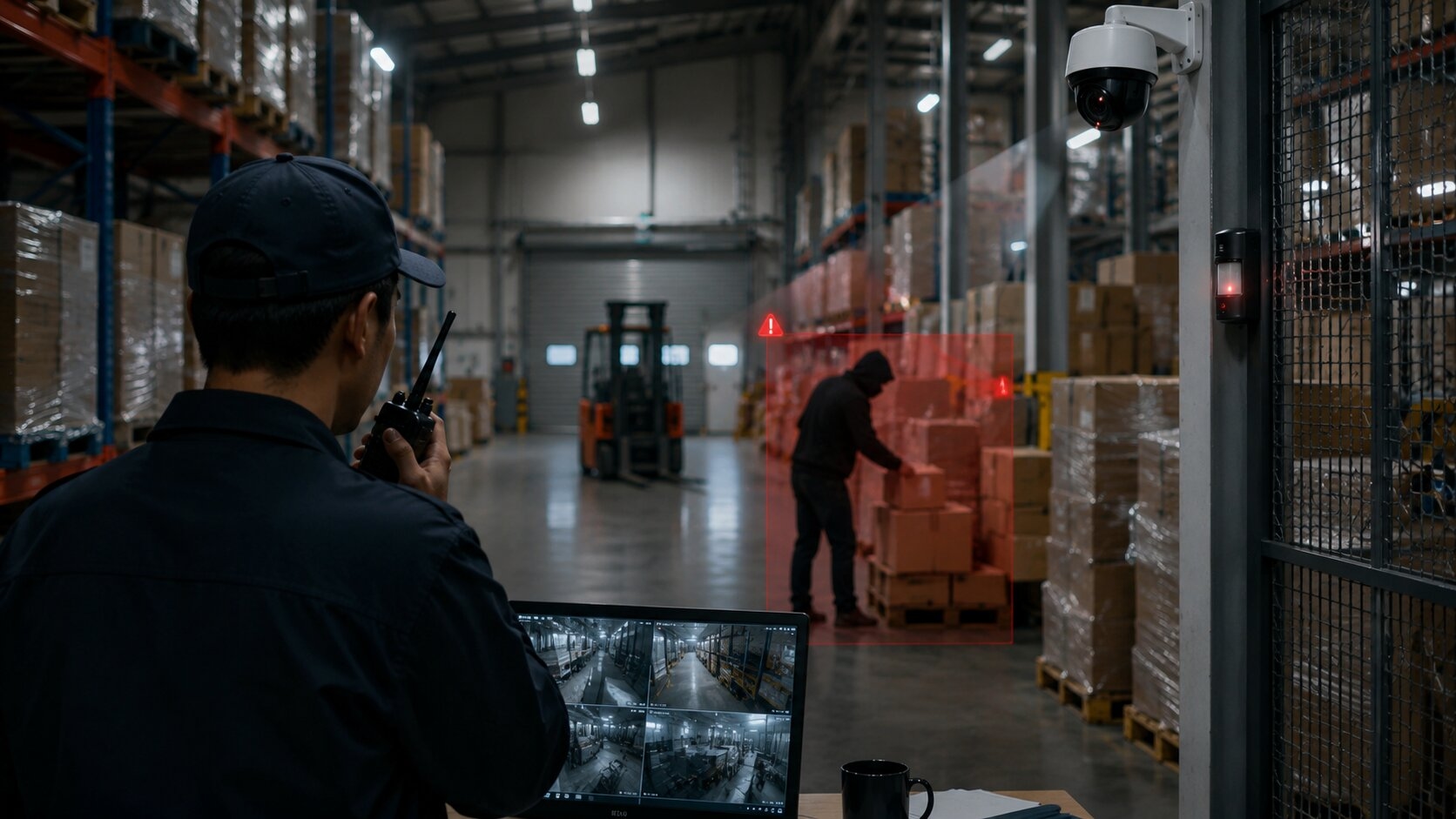
Warehouse theft is prevented through three layers working together: strict access control, visual surveillance that reaches every vulnerable area, and stock audit procedures that run on a regular cycle. All three need to operate at once, because a gap in one layer is usually exploited through another. A warehouse with full CCTV coverage but no exit control still loses goods to insiders walking them out. A warehouse with tight guard coverage but no cycle counting still bleeds stock for months before anyone notices.
Why Warehouses Are Vulnerable to Loss
Warehouse losses generally come from three sources, each with a different character and a different fix.
Internal theft. Committed by employees, contract labor, or anyone with legitimate access to the facility. It usually happens gradually and in small quantities, sized to stay below the threshold that a stock take would catch.
External theft. Break-ins by outside parties, whether through forced entry or by posing as a courier or vendor during loading and unloading.
Administrative loss. Losses that aren't theft at all, but recording errors, mis-shipments, or unreported damage. These are frequently lumped in with theft, when the remedy actually sits in the administrative system rather than in physical security.
The 2025 Cargo Theft Report from BSI Consulting and TT Club places Indonesia among the countries with the highest recorded cargo theft incidents worldwide, alongside Brazil, Mexico, India, the United States, Chile, China, Germany, and South Africa. The same report notes that roughly half of all incidents across Asia occur at warehouses and production facilities, with insider involvement remaining high in Indonesia, India, and China — often in the form of gradual pilferage enabled by weak inventory controls and internal collusion. That finding is a strong argument for why access control and oversight of insiders cannot be treated as a secondary measure.
Vulnerable Points Warehouses Often Overlook
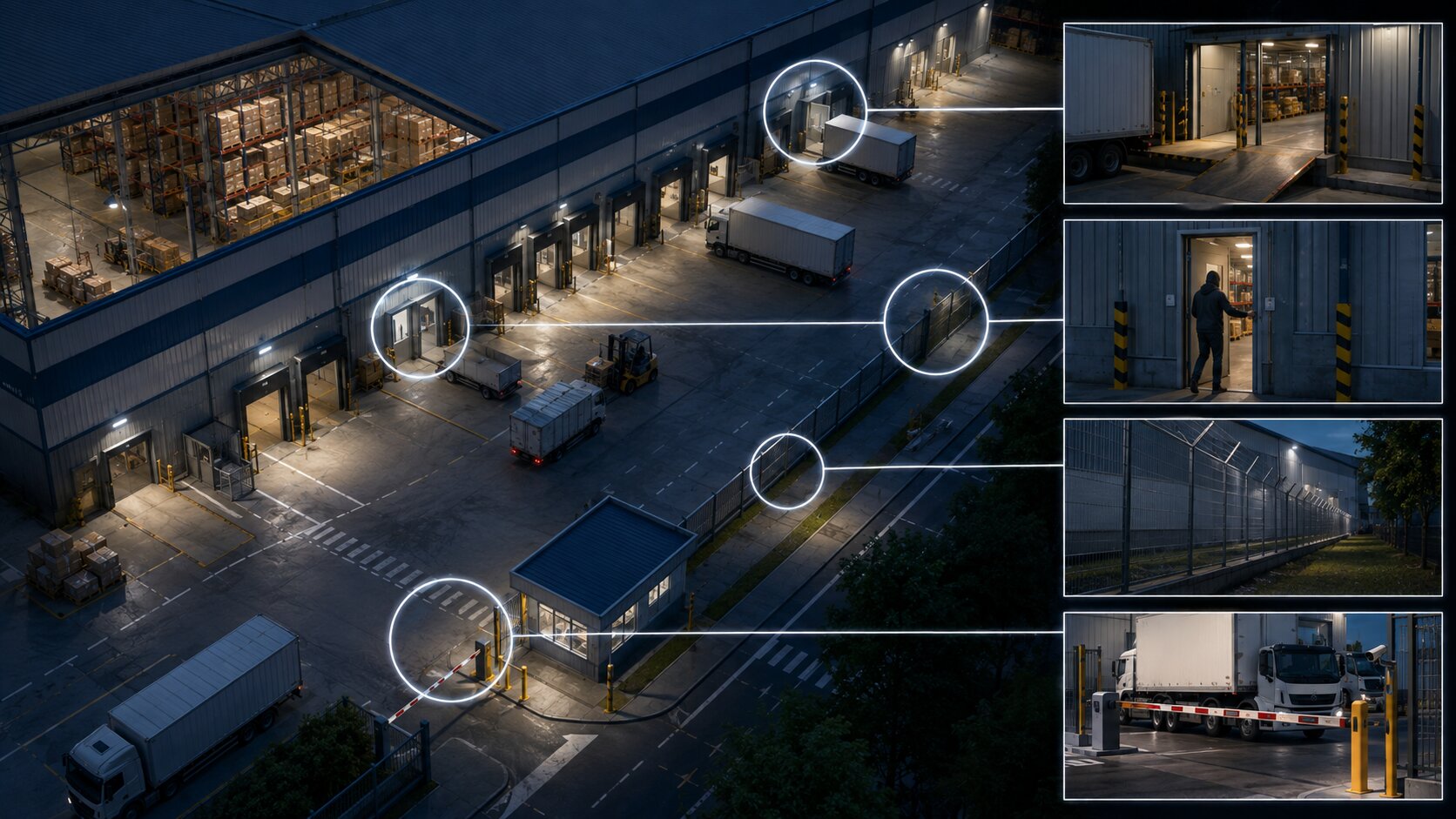
Most theft incidents happen not in the middle of the warehouse, but at transition points — where goods, people, or vehicles move from one zone of control into another.
Loading dock. The point with the heaviest traffic from outsiders (couriers, truck drivers, vendors), and often the least tightly supervised, because it gets treated as a work area rather than a security area.
Receiving area. Incoming goods are frequently staged before being entered into the system, creating a window in which the physical count and the recorded data don't match.
Emergency exits. Designed for rapid egress in an emergency, but often left without an alarm or sensor — which makes them a convenient unmonitored route for goods to leave the building.
Blind spots among high racking. Racks four to six meters tall create zones that fall outside the viewing angle of standard CCTV placement, particularly in narrow aisles between racks.
Seven Ways to Prevent Warehouse Theft
1. Tighten entry and exit procedures for people and vehicles. Every person and vehicle entering the site should be logged with identity, purpose, and time — not recorded in a manual visitor book that is trivial to falsify. Run goods vehicles through a single controlled entry and exit point, require delivery documentation to be checked before any vehicle leaves the site, and separate pedestrian routes from vehicle routes so supervision can be focused. For warehouses with heavy vehicle traffic, a vehicle barrier or boom gate integrated with digital logging is far harder to manipulate than a manual system.
2. Apply dual control to high-value goods. Items with high resale value or that are easy to move on — electronics, branded components, expensive raw materials — should not be releasable by one person acting alone. Require two signatures, or two separate authorisations, for every release in this category: one from warehouse staff, one from a supervisor or the inventory function. Store these items in a segregated area with restricted access rather than mixed into general racking.
3. Run regular cycle counts, not just an annual stock take. An annual stock take only reveals losses once it's too late to act — a discrepancy accumulated over twelve months is very difficult to trace back to a cause. Cycle counting checks a small subset of SKUs each day or week on a rotating basis, so discrepancies surface within days rather than months. Prioritize high-value and fast-moving SKUs for more frequent counts than slow-moving stock.
4. Deploy trained guards on scheduled patrol routes. Guards who patrol without a defined route and schedule become predictable to anyone with bad intent, insiders included. Build patrol routes that cover every vulnerable point listed above, vary the timing and sequence periodically so the pattern can't be read, and make sure every officer holds competency to the applicable standards — including qualification under SKKNI 259/2018 and the operational requirements for security service providers (BUJP) set out in Perpol No. 1/2023. Document each patrol, whether through physical checkpoints or a digital system, so there is an auditable trail.
5. Get lighting and housekeeping right. Goods stacked wherever there is space create new blind spots that never existed in the original layout — and internal thieves tend to know exactly where those blind spots form. Ensure lighting is even across the whole facility, including inter-rack aisles and outdoor areas such as the loading dock at night. Enforce a firm housekeeping rule: nothing stays stacked outside designated racking or areas beyond a set time limit.
6. Integrate the security systems. Cameras, access control, and alarms running as separate systems create gaps precisely where they meet — for example, an access card revoked in the HR system but never deactivated in the access control system. Integration allows a single event, such as an attempted entry outside working hours, to immediately trigger the nearest camera and notify the monitoring team, instead of sitting in a separate log that only gets reviewed after a loss is reported.
7. Screen and train employees. Most internal theft cases involve employees who passed a standard recruitment process, which means screening at the point of hire is not enough on its own. Run appropriate background verification for roles with direct access to inventory and provide periodic training covering how to report missing goods, what operational irregularities look like, and the consequences of violations. Effective training gives concrete examples rather than a general call to "stay alert" with no guidance on what to actually do.
Warehouse Security Equipment Worth Considering
The seven steps above work considerably better when supported by the right equipment. What follows is a set of categories with the considerations that matter before choosing — a framework for assessing need, not a product list.
CCTV and video analytics. Passive CCTV only records footage to be reviewed after an incident; its function is closer to evidence than to prevention. Video analytics adds automatic detection of movement outside operating hours, people entering restricted zones, or vehicles idling too long at the loading dock — any of which can trigger a real-time alert. It suits large sites that guards cannot realistically watch manually around the clock. Assess viewing angles against high-rack blind spots before deciding how many cameras to install and where.
Access control. This ranges from access cards and biometrics (fingerprint or facial) to turnstiles for pedestrians and vehicle barriers for traffic. Cards are easy to deploy but easy to lend out; biometrics are harder to circumvent but demand more maintenance to hold accuracy, including in a tropical climate where high humidity affects fingerprint sensor performance. Choose a combination matched to traffic volume and the risk level of the area being protected — not every door needs biometrics.
Alarm systems and intrusion sensors. Door and window contacts, motion sensors (PIR), and alarms on emergency exits close the gaps that CCTV and access control don't reach, particularly outside operating hours. Look for sensors that integrate with a monitoring system rather than local alarms that simply sound on site. An alarm without a rapid response mainly tells the intruder to hurry; it doesn't prevent the incident.
24-hour monitoring and response. Cameras and alarms only have value if someone is watching and able to act when an alert comes in. Warehouses running 24-hour operations, or holding high-value inventory, should consider centralised monitoring capable of coordinating a physical response within minutes, rather than simply forwarding footage to be reviewed the next day.
System integration. This is the consideration most often skipped when a warehouse buys equipment piecemeal from different vendors — CCTV from one brand, access control from another, alarms from a third, each running in isolation with nothing shared between them. The gaps appear at the seams between separated systems rather than within any individual system. Before adding new equipment, evaluate whether what's already installed can be brought onto a single monitoring platform.

When a Warehouse Needs a Professional Security Provider
Not every warehouse needs a full security system from day one. A few objective criteria are worth using as a guide:
Site size has grown to the point where manual supervision by the internal team is no longer adequate.
Inventory value is high enough that the potential loss from a single incident is material to business operations.
Shift patterns, particularly in warehouses running 24 hours, where handovers create supervision gaps.
Client regulation or audit requirements, especially from Japanese or Korean principals, who typically hold stricter physical security standards as a condition of doing business.
Incident history — theft, break-ins, or recurring stock discrepancies that internal measures have failed to resolve.
Where one or more of these applies, a security assessment by a professional provider is more efficient than patching problems one at a time. SECOM Indonesia approaches this through its Man-Machine philosophy: trained security officers combined with integrated technology monitored from a Control Center, backed by more than 30 years of operation in Indonesia.
If your warehouse meets one or more of the conditions above, the most practical next step is a site survey consultation to map the specific vulnerable points in your facility — rather than applying a generic solution that may not fit your layout and operating patterns.