


Face Recognition Attendance: The New Standard for Warehouses and Distribution Centres
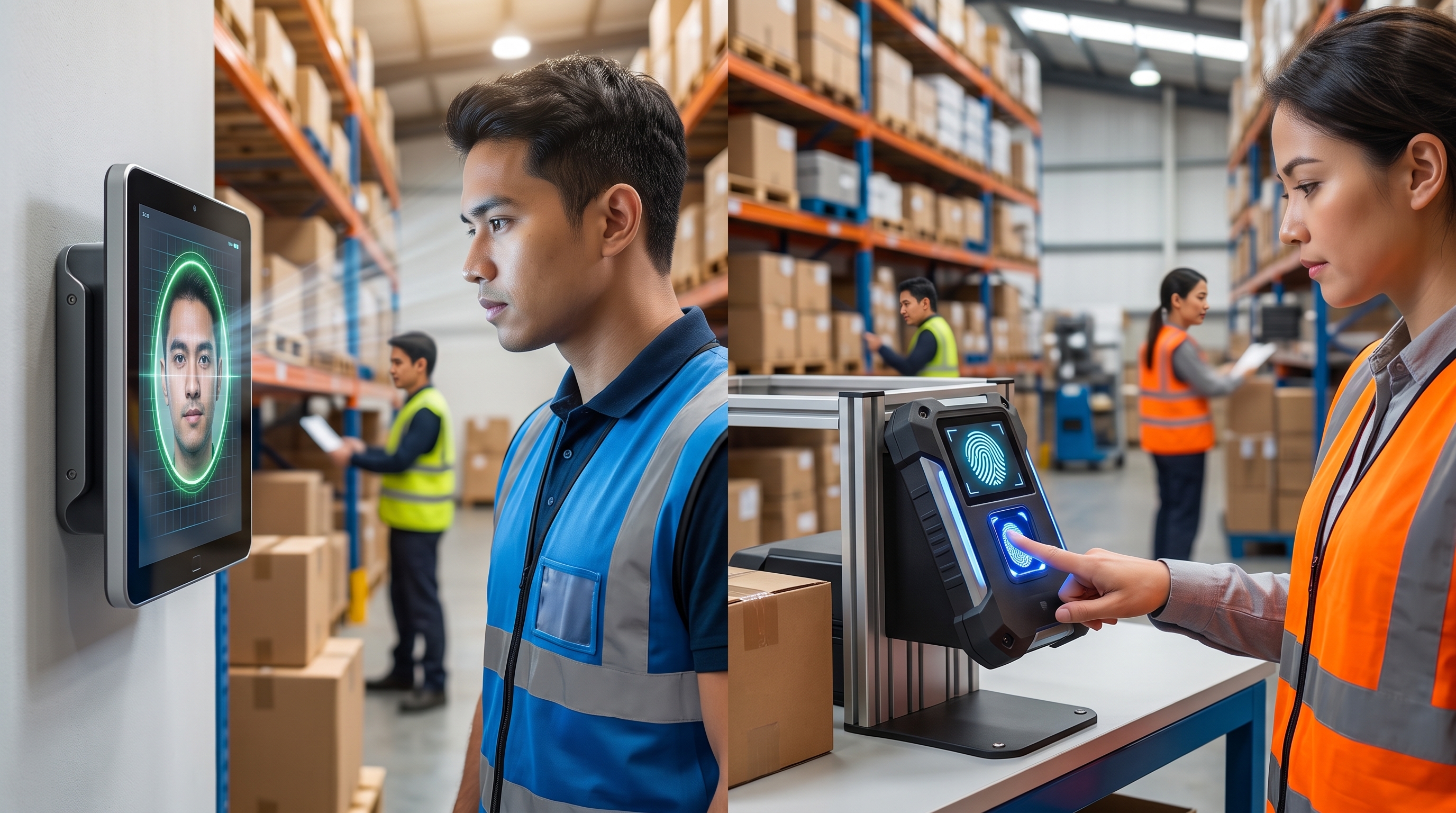
Warehouses and distribution centers have a problem that a normal office does not have. Hundreds of workers rotate through shifts around the clock. Hands get dirty and dusty. Safety gloves stay on for the whole shift. And buddy punching, where one worker clocks in for another, is very hard to catch manually.
Conventional fingerprint machines often fail to read fingerprints that have worn down from heavy physical work. RFID cards are easy to hand over to a colleague. Face recognition attendance answers this exact set of operational problems.
What Is Face Recognition Attendance?
Face recognition attendance is an employee time-and-attendance system that uses biometric face recognition to verify identity automatically. No physical contact. No card.
The system scans the unique features of a person's face, such as the distance between the eyes, the structure of the cheekbones, and the line of the jaw. It then matches those features against the stored data within seconds. This is different from an ordinary CCTV camera: a face recognition terminal also has liveness detection, which confirms that the face in front of the lens is a real person and not a photo or a video.
Manufacturing and warehousing companies are adopting this technology for three main reasons. It is fast. It still works when the worker's hands are dirty or covered by gloves. And it connects directly to the company's access control and payroll systems.
Why It Is Becoming the New Operational Standard
The move away from fingerprints and cards is not only a technology trend. It is a response to three operational needs that keep growing in medium and large companies.
It stops buddy punching
RFID cards and PIN codes can be passed to a colleague. This creates labour cost leakage that is very difficult to trace. Face verification is unique to each person and cannot be delegated to anyone else.
It is fast during peak hours
When hundreds of employees change shift within a window of 15 to 30 minutes, the queue at a fingerprint or card reader becomes a bottleneck. A face scan usually finishes in less than one second per person.
It is hygienic and touchless
Since the public health concerns that followed the pandemic, many companies are no longer comfortable with a device that dozens of people must touch on the same surface many times a day.
Together, these three factors turn face recognition attendance from a "nice to have" feature into a basic operational need for labour-intensive companies.
How Face Recognition Solves Warehouse and Logistics Challenges
Warehouses and logistics hubs have working conditions that often stop conventional attendance methods from performing well. Here are the specific challenges, and how face recognition handles each one.
Dirty, oily, or dusty hands
A fingerprint scanner depends on reading a clean, clear fingerprint. In a warehouse environment with dust, forklift engine oil, or packaging residue, the failure rate of fingerprint readings rises sharply. Face recognition needs no physical contact at all, so the condition of the worker's hands does not matter.
Safety gloves worn during the shift
Many warehouse health and safety procedures require workers to wear gloves for the entire shift, including when they enter and leave the work area. Workers then have to remove their gloves only to clock in. It is a small inefficiency, but it adds up to a large loss of time across hundreds of employees per day.
Heavy shift rotation and high contract worker turnover
Warehouses and distribution centres often hire contract or seasonal workers in large numbers. Registering a new face in the system is much faster than printing a physical access card for every new worker.
Layered access zone restrictions
A warehouse area is usually divided into sensitive zones: high-value storage, the server room, the loading and unloading area, and general zones. Face recognition can be integrated with access control to give each person different access rights for each zone. It also records a movement history, or audit trail, which can be used for investigation if goods go missing.
Integration with the supply chain
Accurate, real-time attendance data allows a logistics company to match its staffing schedule to the daily shipment volume. This reduces unnecessary overtime cost.
Comparison: Face Recognition vs Fingerprint vs RFID
Aspect | Face Recognition | Fingerprint | RFID Card |
|---|---|---|---|
Physical contact | Touchless | Must touch the sensor | Must tap the card |
Performance with dirty hands | Not affected | Often fails | Not affected |
Works with safety gloves | Yes | No | Yes |
Buddy punching risk | None | Low | High |
Speed per person | Under 1 second | 1–3 seconds | Prone to queues |
Vulnerability to forgery | None | Low to medium | High |
Cost of replacing the ID media | No physical media | No physical media | Card printing cost |
Suitability for mass shift changes | Very suitable | Suitable, queues possible | Suitable |
Multi-zone access control integration | Very flexible | Limited | Flexible |
Complete Security Integration with SECOM
Face recognition attendance works best as one component inside an integrated security system, not as a stand-alone device. This is the Man-Machine philosophy that has guided SECOM Indonesia for more than 30 years: advanced technology performs at its best when it is combined with trained personnel and centralised monitoring.
For warehouses and logistics facilities, SECOM integrates the face recognition terminal with:
Access control systems and turnstiles, so that zone restrictions are enforced automatically instead of only being recorded.
The SECOM Control Center, which can monitor your alarm signals if an alarm system is also installed at your warehouse or logistics site.
A Physical Response Team, as an extra layer of security when the system detects an incident that needs verification or direct action on site.
This approach answers what manufacturing, distribution, and warehousing companies actually need. Not simply an "attendance device", but a complete and accountable security system.
Time to switch to SECOM.