


3 Reasons Why Office Buildings Need AEDs
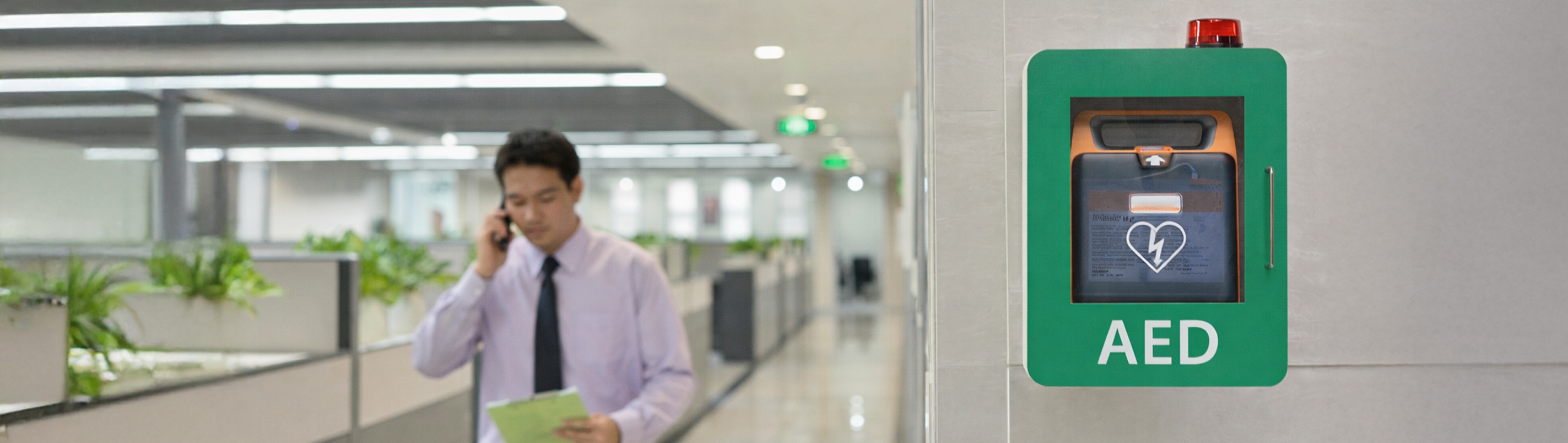
Every year, hundreds of thousands of people in Indonesia experience sudden cardiac arrest, and many of these incidents occur in workplaces or public facilities. These situations often come without warning, in the midst of daily activities.
For office building managers, an important question arises: do regulations in Indonesia already mandate the availability of Automated External Defibrillators (AEDs) in buildings? And equally important, what are the risks, both legally and morally, if a building is not equipped with an AED?
What is an AED?
An Automated External Defibrillator (AED) is a portable medical device that helps save lives during sudden cardiac arrest. This device can detect abnormal heart rhythms and deliver an electric shock to help the heart return to a normal rhythm.
Why is AED Important for Office Buildings?
What makes AEDs so important for office buildings is their ease of use. AEDs are designed to be used by anyone, even by laypersons with minimal training. The instructions are clear and the steps are simple, so they can be used quickly in emergency situations when every second is precious.
That's why AEDs are an ideal solution for non-medical environments such as office buildings, shopping centers, and public facilities, where quick response can be the determining factor between life and death.
Sudden Cardiac Arrest Statistics in Indonesia
Sudden cardiac arrest is not a rare occurrence in Indonesia. Data from the Ministry of Health shows that there are approximately 350,000 cases annually. This means one person experiences sudden cardiac arrest every 90 seconds. More alarmingly, most of these incidents occur outside hospitals, in workplaces, or public spaces, with very low survival rates. Without quick assistance, less than 5% of victims can be saved.
Yet, time is the determining factor. Research from the American Heart Association shows that using an AED within the first three minutes after an incident can increase survival chances up to 70%. Unfortunately, in major cities like Jakarta, the average ambulance response time still ranges from 15-20 minutes, far exceeding the critical golden time for救援.
This gap makes AEDs in office buildings and public facilities not just a complement, but an extremely urgent necessity.
AED Regulations in Indonesia
Compared to developed countries that already mandate AEDs in public buildings, Indonesia is currently in a transition phase. Regulations do exist, but they haven't fully addressed the needs on the ground, particularly for office buildings and non-medical facilities. Here's an overview of AED regulations for buildings in Indonesia.
Permenkes No. 3 of 2020
Through the Minister of Health Regulation No. 3 of 2020 concerning Hospital Classification and Licensing, the government mandates hospitals of class C and above to provide AEDs. This means that in medical environments, the presence of AEDs has become a safety standard.
PP No. 50 of 2012 (SMK3)
Government Regulation No. 50 of 2012 concerning Occupational Health and Safety Management Systems (SMK3) requires companies to provide first aid facilities for accidents (P3K). In principle, this shows that employee safety is the company's responsibility.
Regional Regulations
At the regional level, such as DKI Jakarta through Governor Regulation No. 163 of 2012 concerning Building Permits, multi-story buildings are required to have safety facilities, including first aid. However, there is no specific mention of AEDs.
The fact is, there is currently no specific AED regulation in Indonesia. However, this doesn't mean companies are entirely free from responsibility.
How Do Other Countries Approach This?
While Indonesia still relies on a voluntary approach, many developed countries have gone much further. They've made AEDs a basic safety standard in public spaces. Here are some examples.
Japan
Japan is known as a pioneer of Public Access Defibrillation (PAD) in Asia. Since 2004, the Japanese government has actively mandated AED installation in various public facilities, including:
All train stations & airports
Office buildings with capacity >1,000 people
Schools, universities, and sports facilities
Hotels with >300 rooms
Impact: The survival rate for cardiac arrest victims increased from around 3% in 2003 to 18% in 2020.
Singapore
Singapore takes a practical approach. Through the Workplace Safety and Health Act, AEDs are mandated in buildings with high human traffic, such as:
Shopping centers with areas exceeding 5,000 m²
Star-rated hotels
Sports facilities & gyms
Convention Centers & Exhibition Halls
Interesting note: Singapore also integrates AEDs with technology. Through an application, AED locations are directly connected to the national emergency system.
United States
In the US, AED regulations vary by state. However, the policy direction is increasingly broad and increasingly strong.
36 states mandate AEDs in public schools
The Federal Cardiac Arrest Survival Act provides legal protection for anyone who uses an AED to help others
OSHA recommends AEDs in workplaces with >50 employees or locations with ambulance response times >5 minutes
Although not mandatory, AEDs are viewed as an important part of modern workplace safety standards.
AED Readiness Gap in Indonesia
On paper, AEDs are often considered supplementary facilities. But in the field, the reality is far more concerning. In cases of sudden cardiac arrest, time is everything. Unfortunately, the reality in Jakarta shows major challenges. Traffic congestion, limited ambulance fleets, and the complexity of high-rise buildings make the situation even more difficult.
Why Does Your Building Need an AED?
When it comes to saving lives, waiting for AED regulations in Indonesia often means waiting too long. Here's why more and more companies are choosing to act first.
1. Moral Responsibility & Corporate Reputation
In today's era, employee welfare is no longer just an add-on, but part of a company's identity. Companies that proactively provide AEDs send a very clear message: employee safety is the top priority.
If a fatal incident occurs that could actually have been prevented with quick response & an AED, the impact can far exceed operational aspects. A company's reputation can collapse within hours. Media and social media quickly form negative narratives: "This company failed to protect its employees." Damage like this is often difficult, even impossible, to fully recover from.
2. Legal Risk Mitigation
In certain situations, companies can be considered negligent if:
The risk of cardiac arrest is already known
AEDs have become a global safety standard in work environments
The cost of procuring AEDs is reasonably affordable and not disproportionately burdensome
In this context, the argument "not yet legally mandated" could become very weak if tested in court.
3. Small Investment, High Impact
Financially, the cost of procuring an AED is relatively affordable. Compare that figure with the potential losses that could occur:
Litigation costs
Loss of key personnel
Company reputation damage
Ultimately, the ROI from an AED isn't just about numbers. This is a moral, strategic, and long-term investment about how a company chooses to protect the people within it.
Not Just About Buying Equipment
The most common mistake building managers often make is treating AEDs as merely a compliance checklist: buy the device, mount it on the wall, and consider it done. In fact, an AED without the right support system risks becoming an ineffective investment, even unused when most needed.
SECOM is here with AED solutions and training. We're ready to help you design an effective and integrated security system. Don't wait until it's too late. Every second counts. Equip your building with an AED now.